
Norwalk City Directory Years and Collections
The broad Norwalk directory run is listed from 1871-1991. The Library of Congress microfilm begins in 1882, while the local guide separates the shelves into 1882-1960 microfilm, 1961-1992 local or closed stacks, and originals described from about 1890/91 through 1992. A catalog check still matters for a single year.
| Collection | Years | Where Held | Access |
|---|---|---|---|
| Norwalk directories | 1871-1991 broad run | Norwalk Public Library; Library of Congress microfilm from 1882 | Ask staff for the volume or reel |
| Local microfilm and stacks | 1882-1960; 1961-1992 | History Room, Main Library | Microfilm or staff retrieval |
| Early Norwalk directories | 1874/75 | Norwalk Museum or Town Clerk | Curator appointment or municipal request |
| Cross-reference and telephone directories | About 1980/81 forward | Norwalk Library local-history holdings | In person; confirm the exact year |
The Norwalk Library city-directory holdings page supplies the local date ranges and shelf notes used to choose the next search.
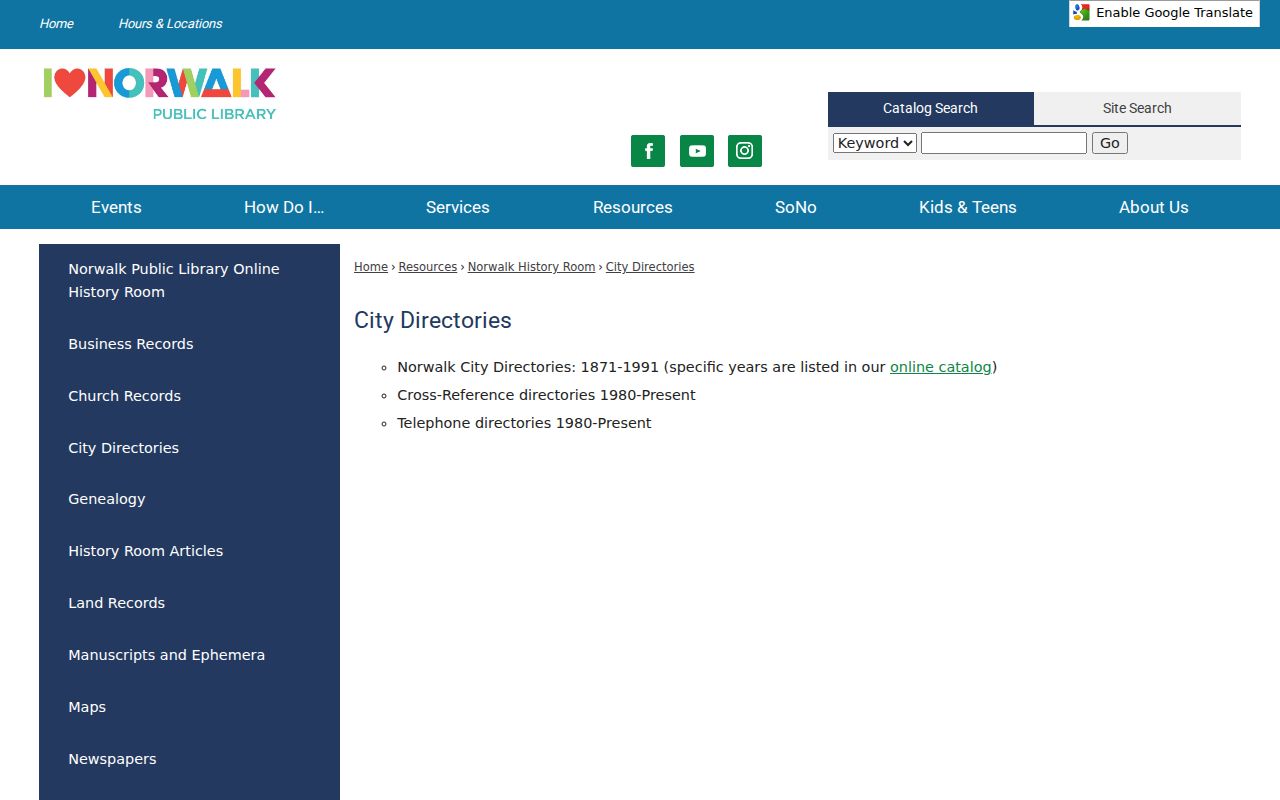
The holdings description helps separate a missing local volume from a year that needs a regional backup.
Norwalk Directory Shelf Access
The Norwalk Public Library History Room is on the lower level of the Main Library at 1 Belden Avenue. The listed phone is 203-899-2780. Hours are Monday, Tuesday, Friday, and Saturday 10:00-5:30, Wednesday and Thursday 10:00-8:00, and Sunday 1:00-5:00.
Directories share the room with yearbooks, newspapers, maps, photographs, manuscripts, and Norwalk records reaching back to settlement in 1651. Staff accept research requests by phone, email, mail, or form. Give a full name, date range, street or address, record type, and whether an image or copy is needed. In person, ask before retrieving material, sign in, leave identification when required, use locked bags when directed, and do not reshelve. A workstation and scanner are available; the History Room lists black-and-white copies at 10 cents and color copies at 50 cents.
The South Norwalk branch is at 10 Washington Street, with a separate 203-899-2790 phone and separate listed hours. Directory requests that need closed stacks, reels, or local-history finding aids belong with the Main Library History Room.
The Norwalk History Room resource page shows the collection and request route for a dated directory search.
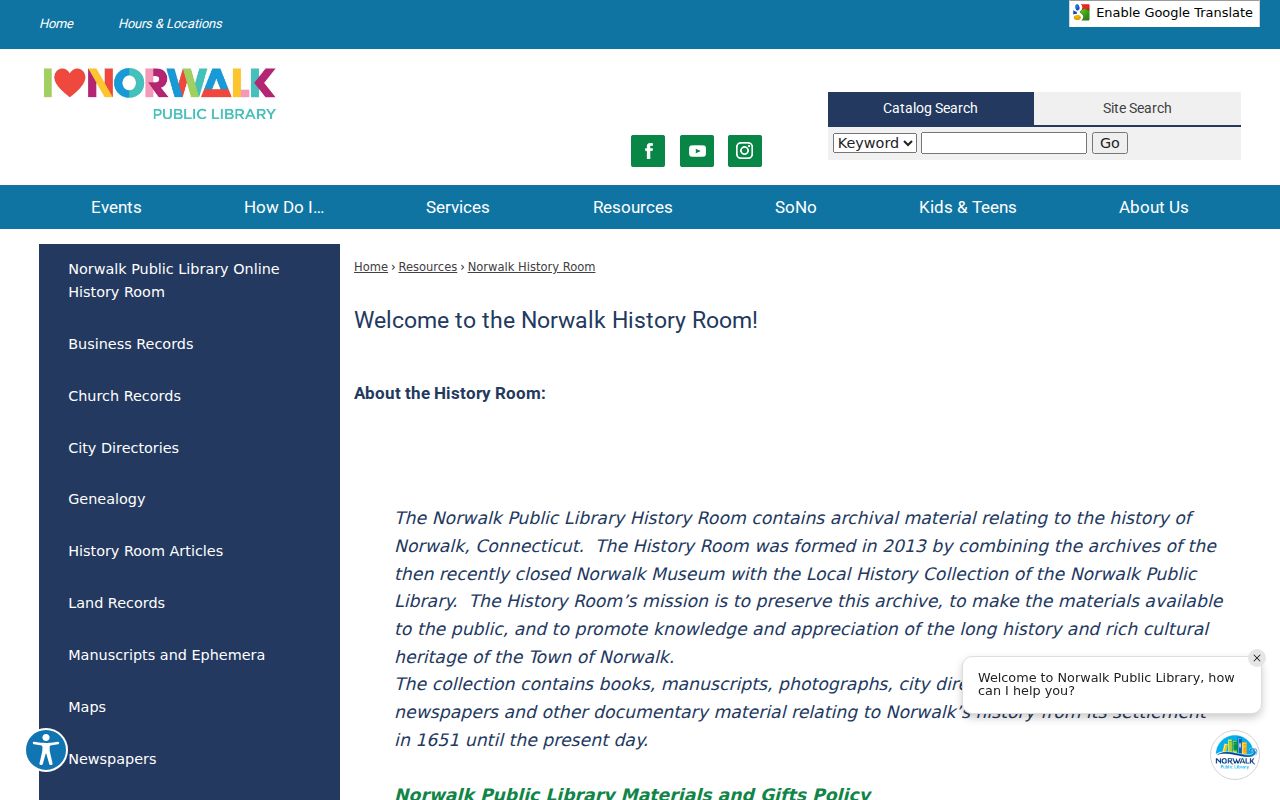
The room’s handling rules matter because some directory material is on microfilm or in closed stacks rather than on an open shelf.
Norwalk City Directory Gaps and Backup Years
The local guide says 1920 and 1943-44 were not published locally. Bridgeport History Center lists Norwalk holdings for 1924, 1926-27, 1929-31, 1934-42, 1946, 1949, 1950-72, 1974, 1976-77, 1979-80, and 1982-91. The Bridgeport city-directory listing is a regional fallback, not proof that every missing year survives there.
For 1874/75, the local guide points to the Norwalk Museum at 41 South Main Street by curator appointment, or the Town Clerk. Ask the History Room to check the catalog before assuming the broad 1871-1991 run is held in one place. Record a gap plainly, then use a newspaper, map, census, or land index to bridge the date.
An early-volume request should name the year, Norwalk, the street or surname, and whether a scan or in-person review is needed.
Note: A missing Norwalk directory year is a collection gap, not proof that no household, business, or event existed.
Reading a Norwalk City Directory Entry
Read the entry as a dated publication, not as a current record. Copy the name exactly, keep initials, and note the street and locality as printed. A spouse, household note, or trade line may help distinguish two people with the same name, but the directory’s own wording remains the evidence.
Read the page heading and abbreviation key before copying a mark. Nearby entries can reveal how the volume treats a street, household, or organization, but an unclear symbol should stay unresolved until the volume explains it.
| Name | Printed head name, initials, and any household note |
|---|---|
| Spouse or household | Parenthetical or separate entry, only when printed |
| Occupation or trade | Transcribe the historical line without treating it as present fact |
| Address | House number, street, unit, and locality exactly as shown |
| Residence mark | Record any owner or occupancy mark, if printed, and check the key |
- Criss-cross directory
- A street-order section that lets an address lead to a name when the surname is unknown.
- Householder index
- An alphabetical route through household heads or principal entries.
- Abbreviation key
- The volume’s explanation of shortened street, role, or residence marks; photograph it before searching.
Norwalk Directory Newspaper Indexes
The cumulative Norwalk Hour index covers births, marriages, wedding notices, and obituaries. Its PDF index runs from 2005 through May 2016, and birth, marriage, and wedding indexing ceased in 2016. The Hour has microfilm from 1895-2006, with missing reels and a 1955 flood gap in the local-history material.
The History Room also provides a digitized Norwalk Gazette run from May 6, 1818 through April 24, 1883, plus NewsBank coverage for the Historical Norwalk Hour Weekly from 1874-1921 and Daily from 1895-2009. An index points to an article. Save the surname, initials, item type, date, page, and reel or PDF reference, then retrieve the article before stating a relationship or address.
The library’s resource hub also lists the New York Times historical run from 1851-2003, the Hartford Courant from 1764-1922, partial HeritageQuest census coverage from 1790-1930, and CT iCONN and Ricker material to about 1850. These companion sources can supply a date or notice when a Norwalk directory year is missing.
Norwalk Directory Vital Aids
The local-history guide lists vital-record microfilm from 1848 to about 1900, Barbour/Ricker, the 1934 Hale Headstone Collection, newspaper marriage and death transcriptions, and monthly vital extractions from about 1903 to at least 1940. Town Clerk material includes births 1848-1898, death and marriage books and indexes to 1898, a burial volume for 1885-1920, burials from 1924-1989 with gaps, and removals from 1909-1950.
Early records can sit in land-record volumes. Use a directory or finding aid to identify a date and source, then use the Norwalk Town Clerk or the state vital-record route for an eligible certified copy. A transcription, cemetery reading, and index are useful leads, but they are not the same as the official certificate.
Note: A finding aid points to a record; it does not replace the certified copy or original held by the custodian.
Norwalk Directory Land Indexes
When a dated address needs a property bridge, Norwalk Library’s land-record resources point to Herbert Smith indexes, maps, and estates, Malcolm P. Hunt transcripts for Norwalk land records, maps, and transcripts from 1651-1800, and the Home Lots material. The FamilySearch Norwalk land-record catalog lists records from 1652-1915, a general index from 1652-1856, and 51 microfilm reels, with originals at Norwalk Town Hall.
These sources can lead from a directory street to a book and page, but they answer a land-record question rather than proving who slept at an address. Keep the directory date, party role, map reference, and recording reference in separate notes.
The FamilySearch catalog keeps the long time span visible when a Norwalk directory search reaches beyond the modern parcel portal.
Its catalog entry is a route to the reel or original, not a substitute for reading the recorded instrument.
Norwalk City Directory Geography After 1913
Norwalk, South Norwalk, and East Norwalk consolidated in 1913. The city seal’s bridge, well, and Roger Ludlow monument preserve the story of those three historic areas. A directory may therefore use South Norwalk or East Norwalk as a civic label even when a modern search returns Norwalk.
Search the old label beside Norwalk, then compare the street, map grid, newspaper date, and current record. Rowayton, Five Mile River, Silvermine, Cranbury, West Norwalk, Wolfpit, Golden Hill, and Broad River are useful historical or neighborhood search terms, not replacements for a deed description. The Norwalk historical introduction supplies the consolidation and local chronology.
The Norwalk Historical Society at 2 East Wall Street adds museum, exhibit, and publication context for records that do not appear in a portal.
Institutional context can explain why the same Norwalk address appears under different locality words in different years.
Using Norwalk City Directories for Family History
A household trail works best when each volume supplies a date, name, and address, and a different record supplies a check. Pair directory years with the nearest available federal census year, while remembering that a directory is a publication and a census is a separate enumeration snapshot.
- Choose a surname, spelling variant, street, and date range, then check the alphabetical entries.
- Copy the address and household wording, including initials, spouse notes, and any residence mark.
- Compare the next directory year or two to mark a move, a new household, or a missing listing.
- Pair the dated address with the nearest census schedule and keep the two source dates distinct.
- Test the ending with the Hour index, Gazette, vital or burial aid, probate lead, or Town Clerk record.
Disappearing from a volume can mean a move, death, a skipped publication, or an unlisted resident. It cannot be assigned one meaning without another dated source. When the question becomes one address traced backward, the Norwalk previous residents search keeps the deed and household layers together.
Norwalk Directory Timeline
Dates help prevent a later city label or catalog note from being projected onto an earlier entry. Keep the publication date, event date, and record date in separate fields.
| 1651 | Norwalk settlement date used by local-history collection descriptions |
|---|---|
| 1871 | Broad Norwalk directory run begins in the library listing |
| 1874/75 | Early directory material is directed to the Museum or Town Clerk |
| 1882 | Library of Congress microfilm begins; local microfilm continues through 1960 |
| 1913 | Norwalk, South Norwalk, and East Norwalk consolidate |
| 1955 | Flood history coincides with a gap in Hour microfilm coverage |
| About 1980/81-1992 | Cross-reference and telephone material appears in the later local holdings |
| 1991 | Broad directory run ends in the library listing; local guide describes holdings into 1992 |
That timeline makes a clean research note: name, address, locality, source, and date. A strong conclusion preserves the gap when no volume, article, or original record is available.