
Norwalk Resident Lookup Records
A Norwalk person search is a chain of records, not a single name list. Start with the source that matches the question, then add a second source that tests identity, date, or role. Municipal, court, probate, vital, voter, credential, business, and correctional systems each fill a different gap. Retain the source date and access limit.
| Record | What It Confirms | Where | Access |
|---|---|---|---|
| Property roll | Parcel, PID, owner or mailing and situs fields | ACT DataScout and field card | Online lead, assessor terminals |
| Town Clerk land index | Recorded parties, instruments, book and page | Norwalk land records | Online index, counter, copies |
| Civil and probate | Case names, party roles, docket or probate number | PD51 Probate lookup and court inquiry | Public index, clerk verification |
| Vital records | Birth, death, or marriage event and copy eligibility | DPH forms and Town Clerk | Forms, ID, statutory limits |
| Voter status | Name, address, current residence, status, party | Norwalk Registrar and state lookup | Narrow public result, privacy rules |
| Credential or entity | License detail, business ID, principal or agent | eLicense and Secretary of the State | Public lookup, field-specific |
| Current-status lead | DOC status or local incident entry | DOC and Norwalk Police Records Unit | Daily or local lead, not complete history |
If an address is known, use the parcel and land-record route first. If only a name is known, test each system separately rather than joining same-name hits. A Town Clerk entry, court document, certified copy, or agency result carries more weight than a map, ZIP, or directory reference. The Assessor, Town Clerk, court clerk, Registrar, library, and state custodians provide fallback channels.
Norwalk Resident Records Source Ladder
The strongest order is Town Clerk, Assessor, court, probate, or DPH record, then a Connecticut state portal, then a dated library or archive item. A custodian can answer a narrow request. When the question shifts to nearby addresses, use the Norwalk street directory for the address trail.
A recorded instrument or certified copy is direct; a land index, court result, probate table, assessor card, eLicense result, or state business result is an official index. A directory, newspaper index, map, or archive guide is an institutional lead. Keep “not found,” “not public,” “not machine-readable,” and “not searched” separate.
Norwalk Name and Address Controls
Same-name errors need controls. Keep each source spelling and a normalized form for street prefixes, suffixes, units, ZIP+4, and historic street names. Compare address, date, and role. Owner, grantor, grantee, trustee, party, attorney, petitioner, respondent, informant, registrant, and licensee are different roles.
- Write the full name, spelling variants, supplied address, approximate date, and question before searching.
- Use My Norwalk or the property roll to carry an address to a parcel or PID, then compare the field card and Town Clerk index.
- Run the court party search with the exact surname, a first name when known, and separate Starts With or Is Equal To tests.
- Compare the result's party role, location, dates, address or property detail, and case type before joining it to the person.
- Ask the responsible clerk or agency for a certified copy or detail when the index is not enough.
- Docket
- The stable identifier for a court case, built from location, category, year, number, and suffix.
- Index versus image
- An index is a searchable pointer. The image or document is the underlying filing, deed, or certificate and may require a clerk request.
- Certified copy
- A copy issued or authenticated by the custodian, used when a plain portal result is not sufficient.
When two rows cannot be reconciled, preserve both rows and state the missing bridge. A blocked voter form, absent deed image, incomplete probate result, or historic address without a current PID is an unresolved lead, not permission to guess.
Norwalk Resident Lookup Court Fields
Connecticut Judicial Branch Civil Inquiry has a party search for the name side of the trail. Party Last Name is required, First Name is optional, and the page offers Location, Case Category, Case Type, Sort Order, and four name-match modes. A Norwalk search should preserve the selected location and category because a party may appear in the Stamford-Norwalk Judicial District, a session, or another location.
The Connecticut civil party search shows the controls that shape a Norwalk one-person search.
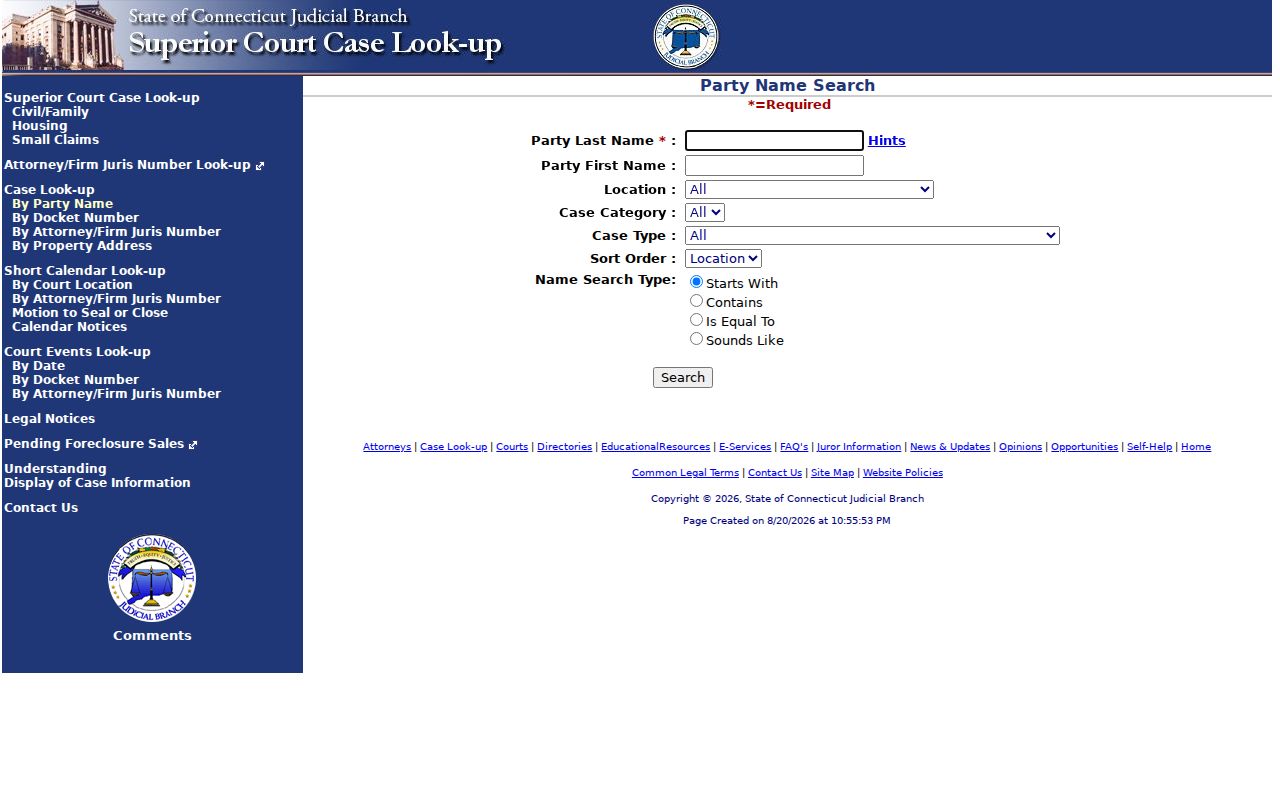
Use a name hit as an index lead only. The Judicial Branch states that the online result is not the official court record, so verify the party role, docket, disposition, and any document with the clerk.
| Field | Norwalk lookup use |
|---|---|
| Party Last Name | Required, maximum 54 characters |
| Party First Name | Optional, maximum 50 characters |
| Location | All, judicial district, session, and UIFSA choices |
| Case Category | All, CV, or FA |
| Case Type | Coded case-type list |
| Sort Order | Dropdown result ordering |
| Name Search Type | Starts With, Contains, Is Equal To, or Sounds Like |
Norwalk Resident Lookup Dockets and Property Search
A docket search uses a location, category, two-digit year, seven-digit number, and suffix. The portal format example is HHD/CV/04/1234567/S, with an option to enter the full number with hyphens. Optional scope can include party information and motions, pleadings, or documents set to none, all, or the last 10. A party list is not the same as a pleading.
The court's property-address search is a second route when an address is the anchor. City/Town is required with at least three characters and partial matching. Street Address and ZIP are optional, while Property Type offers Residential, Commercial, or All and Case Status offers Active, Disposed, or All. Foreclosure coverage reaches return dates after January 1, 2014, and Norwalk session material after March 1, 2016. Selected address-related entries are removed after statutory periods. The portal is a convenience lookup, not an official record.
The court property-address search illustrates the address fields used beside a name search.
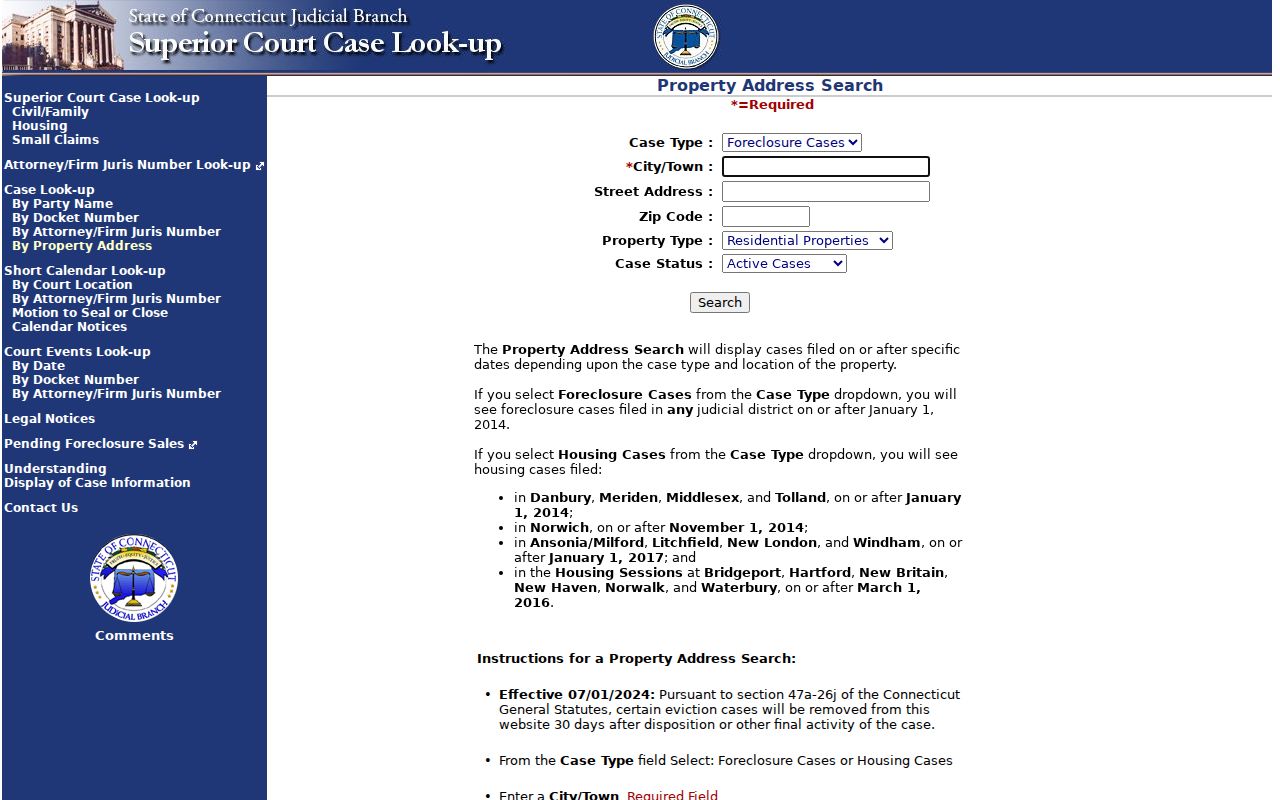
Keep a sample result inventory with the exact visible fields: party name and role, docket number, court location, case category and type, date or disposition when shown, property or street detail, case status, and the document scope selected.
A Norwalk assessor example gives a second kind of lead: parcel 5-23-10-0, PID 13598, situs 238 West Rocks Rd, and deed reference Book 705/Page 165. The card is marked “Not a Legal Document,” so the Town Clerk must verify the instrument.
- Record the docket number as the stable case key.
- Record the court location and category, not just the person's name.
- Note whether the result is active, disposed, or absent from the public display window.
- Ask the clerk for the underlying document when the index does not show the needed fact.
Norwalk Vital Rules for a Lookup
Vital records answer event questions, but eligibility comes before payment. Connecticut birth records under 100 years are restricted under CGS §7-51. Eligible requesters include the adult registrant and listed close relatives or authorized agents, subject to the rule and identity proof. Birth records at least 100 years old have broader adult access, while adoption, parentage, gender-change, surrogacy, and Social Security information remain subject to statute or redaction.
Adults can generally request certified death and marriage copies, but Social Security numbers have narrower access and are redacted from other copies. Norwalk local forms list $20 per copy for death and marriage requests, with requester identity, relationship, signature, and mailing details. State and local forms differ, so use the current Town Clerk or DPH route. A library index, transcription, or newspaper notice can locate an event, but it is not a certified copy.
Norwalk Resident Credential and Entity Checks
Connecticut eLicense is a real-time primary-source credential lookup. Its controls can include License Type, Type Prefix, Number, SubCategory, License Status, Business Name or DBA, First Name, Last Name, Address, State, City, ZIP, Country, Specialty, and Practice City. Fields vary by credential type. The public search showed no login or payment requirement, and a detail popup or link supplies the result information.
The Connecticut eLicense lookup shows the credential fields that can help separate people with similar names.
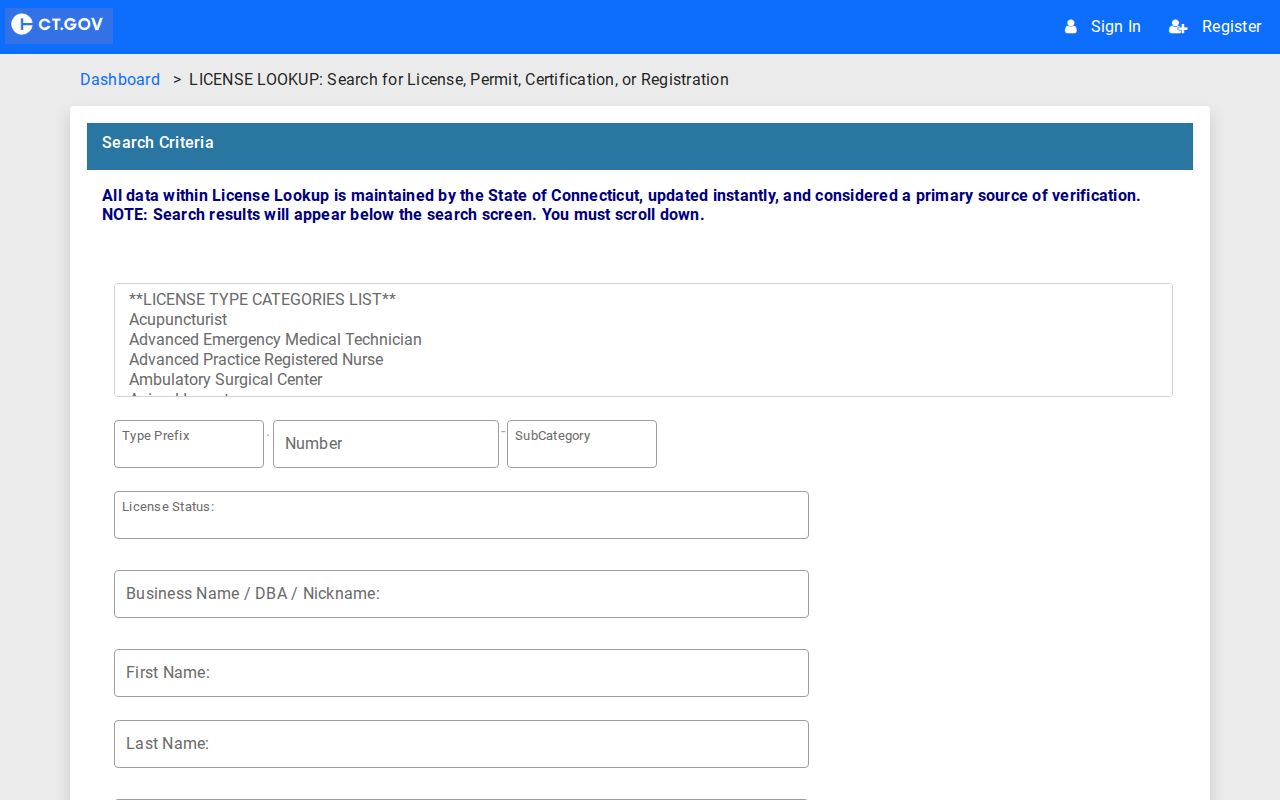
For an entity, the Secretary of the State search uses business name, ALEI, or filing number. Results show business name and ID, principal, registered agent, formation date, entity type, address, and an annual-report PDF. Its dynamic portal had a CSS error, so confirm current controls live. A credential or business role is not proof of residence.
The Secretary of the State's official business-search help remains the fallback for the documented entity result fields.
Norwalk Current-Status Resident Leads
Connecticut DOC provides a daily statewide status surface. Fields include name, DOC number, date of birth, status, offense, location, admission and sentence dates, minimum and maximum or estimated release dates, detainer, photograph, correctional history, and disciplinary history. The search excludes youthful-offender and ICE populations, and “Accused” is not convicted. Record the update date and use a court clerk for the case record.
The Connecticut DOC search is the source assigned to this current-status view.
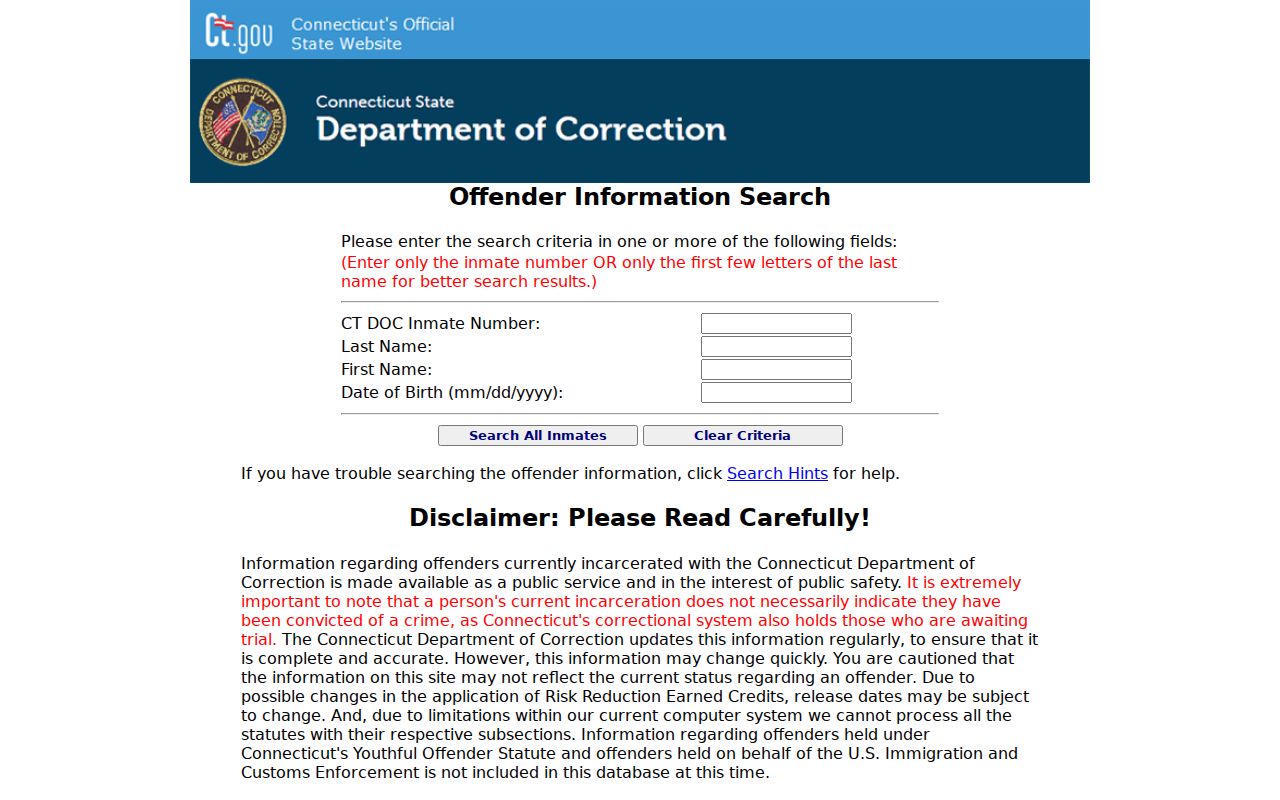
The DOC result should be dated before comparison with Norwalk Police logs, a local lead for arrest, citation, and incident entries, not a complete history. The Records Unit accepts written requests with case number, date, and type; investigations and redactions can limit release.
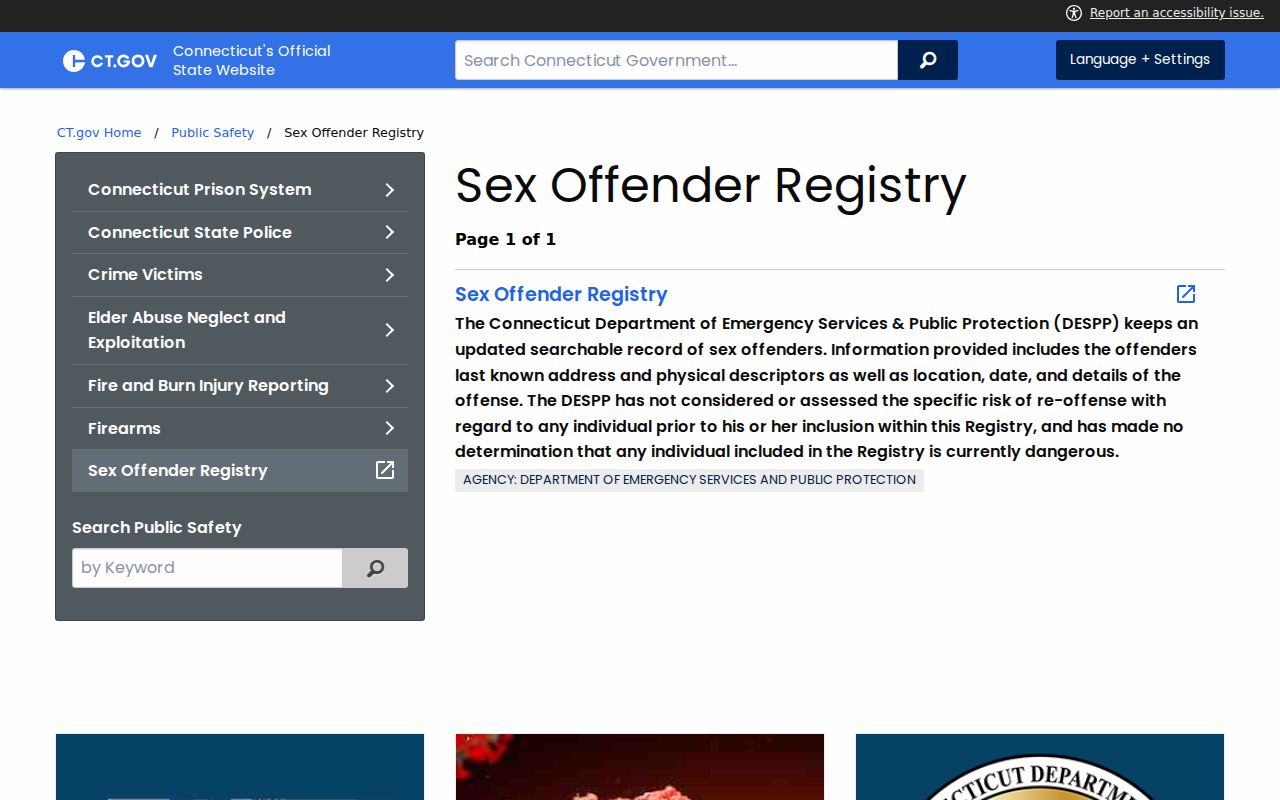
The DESPP registry describes a searchable public record with last known address, physical descriptors, and offense location, date, and details. It warns that the registry is not a risk assessment, and its live controls were not fully exposed during inspection.
The Connecticut registry source supplies the public fields and limits for this part of the status search.
Each system answers only its own status question. A no-result may reflect release, transfer, protected data, spelling variation, or another custodian.
Norwalk Resident Lookup Trails for Human Use
For an heir or estate question, PD51 Norwalk-Wilton accepts case type, district, status, last name, and first name. Results show case number, names, middle initial, type, and district. Listed data runs from January 5, 2011 forward, and pre-2011 material is incomplete. Use the clerk when dates or asset detail are missing.
For family history or reconnection, the Norwalk History Room can bridge a surname and street to a dated directory, newspaper, yearbook, map, or manuscript. The historical volumes are cataloged in the Norwalk directory book. The Norwalk Hour index points to notices, but the article or microfilm must be retrieved. South Norwalk and East Norwalk also need a date check because the three civic areas consolidated in 1913.
The Norwalk History Room accepts phone, email, mail, or form requests. Staff can identify a reel or volume; the Town Clerk or DPH remains the route for an eligible certified copy. The newspaper pointer is separate from the Norwalk Hour index article.
Norwalk Resident Privacy Limits
Connecticut's Freedom of Information Act, CGS §§1-200 through 1-242, opens non-exempt records but preserves specific limits. Birth details under 100 years, Social Security numbers, sealed court matters, victim identity, and protected voter information can be withheld. The current public voter rule releases only the year of birth. A state lookup Request Rejected response is not proof that a person is absent.
Safe at Home can substitute a mailing address and protect a participant's physical address. Do not reverse-engineer an ACP address from a parcel, voter result, map, utility record, or missing row. If an online route fails, use a narrow phone or email request, the Town Clerk or Assessor counter, the Stamford-Norwalk clerk, Registrar, library, archive, or current mail form.
The Connecticut Address Confidentiality Program explains the substitute-address route and its limits.
Lawful personal use. A Norwalk person search is appropriate for personal, lawful research such as family history, reconnecting, civic questions, or a property record trail. Keep only the minimum needed, and never use a name trail to stalk, harass, threaten, or intimidate anyone.